Marker lights
 Tail lights
 Work lights
 Interior lights
 Strobes
 Beacons
 Flood and spot lights
 Roof sets
 Light bars
 License plate light
 Clearance lamps
 Headlights
 Replacement lights
 Reversing cameras
 Brackets & Connection
 Phone / Tablet
 Reflective material
 Brand names
 New at MobiLED
 White
White Amber
Amber Red
Red Yellow
 Green
Green Blue
Blue Transparant
 Multi color
 Double burners
 Classic
 Round
Round Half round
 Long
Long Top lamps
 Talmu
Talmu Freedom
 FOR9T
FOR9T Mounting material
 Clearance sale
 Clearance sale
 Compact
 Universal
 Trailer
 Trailer triangle
 Model Hamburger
 Fristom 313-314 Serie
 Z-T040 Series
 Fristom 110-113 Series
 Round
Round Pentagonal
 Mist - reversing light
 Brake lights
 Slim-line
 Strands block lamps
 Strands Dark look
 Ledson Breeze X1
 Fristom 120-220 Series
 Fristom 130-170 Series
 Fristom 230 Series
 Fristom 270 Series
 Fristom 370 Series
 Fristom 371-372 Series
 Fristom 320-400 Series
 Fristom 330-332 Series
 Fristom 500 Series
 Fristom 600 Series
 Fristom 700 Series
 Horpol Carmen
  Horpol Roca
 Horpol Cleo
 Horpol modulair
 Aspock MultiLed IV
 Lucidity L26060
 LED Autolamps 80-100 Series
 WAS W170 Series
 WAS W184-W185 Series
 WAS W187 Series
 WAS W150DD Series
 Trailer lighting sets
 WAS W225-W228 Series
 WAS W248-W252 Series
 Combi led bar - rear light
 Wiring harness bayonet
 Standard
 Pro series
 Top series
 Light bars
 With position light
 Under cover
 With strobe
 AGRI
AGRI Built in / mounted
 Scene lights
 Mini
Mini Forklift
 ADR
ADR Inspection lights
 Handle / switch
 Clearance sale
 Clearance sale
 Elongated
 Round
Round Other shapes
 Amber
Amber White
White Red
Red Blue / green
 With position light
 Halo
Halo Small
Small Warning / work lights
 License plate
 Dash lights
  Road works
 Tail lift
 Mounting material
 Clearance sale
 Din mount
 Fixed mount
 Magnet mount
 Blue / green
 Mounting material
 Clearance sale
 Clearance sale
 M-LED
M-LED Ledson EPIX
 Spotlights large oval / rectangle
 Spotlights large round
  Spotlights large square
 Spotlights White
 LAZER Sentinel
 Optibeam
 LAZER Racepod
 LAZER Carbon
 Spotlight small
 Flood lights
 Side shooters
 Small
Small M-LED Slimline
 M-LED Road Pilot
 Optibeam dark look
 Delta
Delta Large
Large ECCO 12+ Series
 ECCO 13 Series
 ECCO 6 Series
 Narrow
 Traffic advisors
 Control panels
 Clearance sale
 License plate
 M-LED Gladiator
 M-LED Sergeant
 Ledson EPIX+
 Ledson ORBIX+
 M-LED HD Black Series
 Optibeam Savage
 Optibeam Super Captain Dual
 Optibeam Pure
 With flash function
 OZZ Black
 OZZ White
 LAZER Linear
 LAZER Triple-R
 LAZER Air
 LAZER Glide
 LAZER Carbon
 LAZER Grille kits
 With position light
 Strands Siberia
 Strands Siberia XP
 Strands Siberia curved
 Strands Siberia XP Curved
 Strands Night Guard
 Combi led bar - Rear light
 C-type basic
 D-type basic
 Curved
 Clearance sale
 Clearance sale
 Small
Small Red position light
 License plate
 Led bar
 M-LED Danish model
 Danish model
 WAS W74 Series
 Vignal
 Lucidity
 Aspöck Superpoint Series
 WAS W48-49 Series
 Horpol LD500 Series
 Horpol Dragon Series
 Horpol LD700 Series
 Horpol LD2100-3110 Series
 Fristom 140 Series
 Fristom 145 Series
 WAS W148 Series
 WAS W269 Series
 Fristom 146 Series
 WAS W168 Series
 Horpol LDCC Series
 Hanging
 Universal
 Pablo Spanish lamp
 Pendent lamps action set
 Clearance sale
 Clearance sale
 Headlight units
 Position lights
 Headlight sets CR-3024
 BA9s
BA9s BA15s
BA15s BAU15s
 BAY15d
 SV 8.5
 W2x4.6d (T5-W2W)
 W2, 1x9,5d (T10-W5W)
 W2x4.6d (P27/7W)
 W3x16d (W21W)
 W3x16q (W21/5W)
 H1 (p14,5s)
 H3 (PK22s)
 H4 (P43t)
 H7 (Px26d)
 H8 (PGJ19-1)
 H9 (PGJ19-5)
 H10 (PY20d)
 H11 (PGJ19-2)
 H15 (PGJ23t-1)
 H16 (PGJ19-3)
 H18 (PY26d-1)
 H19 (PU43t-3)
 HIR1 (PX20d)
 HIR2 (PX22d)
 HB3 (P20d, 9005)
 HB4 (P22d, 9006)
 R2 (P45t)
 Complete sets
 Monitors
 Cameras
 Accessories
 Clearance sale
 Cables
 Heat shrink tubings
 Cable ties
 Cable seals
 Junction boxes
 Sockets
 Electrocoils
 Connectors
 Control panels
 Switches
 Cable sets
 Relays and fuses
 Assortments boxes
 M-LED Cable terminals
 Pliers and press tools
 Brackets
 Resistors canbus
 Battery terminal clamps
 Cable sets bayonet
 Jumper cables
 M-LED
M-LED Lazer
Lazer Fristom
 OZZ
OZZ Horpol
 Strands
 Optibeam
 WAŚ
WAŚ  Osram
Osram Crawer
 OLEDONE
 LED autolamps
 TruckLED
 Scanstrut
 Ollson
 Hella
Hella Aspöck
 Gylle
Gylle Juluen
 Ledson
 SAE
SAE Avery Dennison
 X-Visison
 Bullboy
 W-Light
 Lucidity
 Omnius
 Philips
 Ecco
Ecco


Lumens and LED lighting – how to choose the right work light
What do lumens really say about LED work lighting?
When choosing LED work lights, the first thing people often look at is the number of lumens. It is commonly thought that the higher the lumen count, the better the light. In practice, however, this is not always the case.
The number of lumens does not tell the whole story regarding visibility during work. For high-quality LED work lighting, lux and the beam pattern are also of great importance. In this blog, we explain what lumens and lux mean, the difference between them, and what you should look out for when choosing the right LED work light.
What is lumen?
Lumen indicates the total amount of light a lamp produces. It is the unit of measurement for the light output of an LED work light. Therefore, a 3,000-lumen lamp produces more light than a 1,500-lumen lamp.
However, the lumen count says nothing about how that light is distributed. In practice, two LED work lights with the same lumen rating can produce very different lighting results.
A practical example
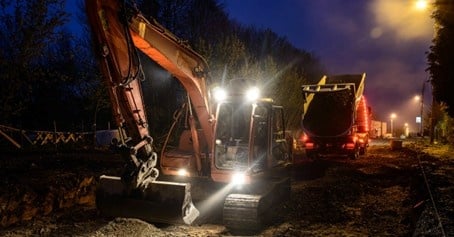
An earth-moving machine equipped with a compact 4,000-lumen LED work light may offer less visibility than a well-designed 3,000-lumen work light with a superior beam pattern. The difference lies not in the quantity of light, but in the way the light reaches the work surface. This is a common occurrence with work lighting for agriculture, transport, and off-road vehicles.
What is lux and why is it at least as important?
Lux indicates how much light actually falls onto a surface. The higher the value, the better the surface is illuminated.
1 lumen is 1 lumen per m2
This makes lux a better indicator of the usability of LED work lighting than the lumen count alone. A lamp with high lumens but poor beam focusing can still provide low lux levels exactly where you need it.
A Practical Example
In roadside assistance (recovery), it is vital that the work area directly in front of or behind the vehicle is well-illuminated. An LED work light with a high lux level at a short distance is more effective here than a lamp that spreads its light too widely.
The Importance of the Beam Pattern
The beam pattern determines how the light is distributed. This is crucial for comfort, safety, and working efficiently with LED lighting.
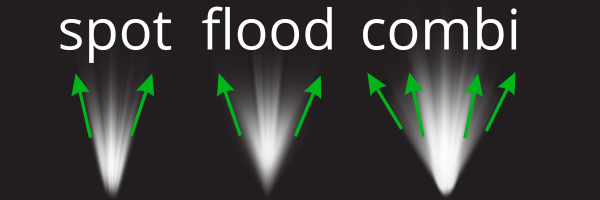
Common Beam Patterns:
- Spot Beam (Verstraler)
Suitable for long-distance visibility, for example, during off-road driving. - Flood Beam (Breedstraler)
Suitable for close-range work, such as loading, unloading, and maintenance. - Combo Beam
Combines both wide and long-range light; often used on agricultural and earth-moving machinery.
A good beam pattern prevents:
- Harsh shadows
- Glare from reflections
- Eye fatigue during prolonged use
Why more lumens are not always better
In practice, we often see requests for LED work lights with the highest lumen count, even though this is not always the best choice. Potential disadvantages of too many lumens include:
- Reflection on wet ground or metal parts
- Blinding yourself or your colleagues
- Unnecessarily high energy consumption
A well-tuned LED work light with a sophisticated beam pattern often delivers better performance than an extremely powerful lamp without focus.
What does this mean for your choice of LED work lights?
When choosing the right LED work lighting, it is wise to look beyond just the lumen count. Ask yourself the following questions:
- At what distance do I need clear visibility?
- Do I primarily need a wide spread or a focused beam?
- In which conditions will I use the lighting (dust, rain, mud)?
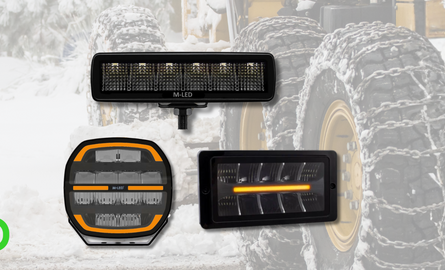
M-LED's LED lights are developed with these practical factors in mind. It’s not just the number of lumens that counts, but specifically the combination of light output, beam pattern, and durability. This makes them suitable for intensive use in transport, agriculture, earthmoving, and recovery services.